What makes SAIHM different: built for compliance, not bolted on
· SAIHM · for CISOs, DPOs, and anyone comparing AI memory tools · ~8 min read
Ask most AI memory tools what they do and you hear the same sentence: they remember things for your AI so it does not start from scratch every session. That part is table stakes. SAIHM does it too. The question worth asking is not whether a tool remembers — it is how it is built underneath, because that is what decides who can read your data, whether a delete is real, whether the memory follows you, whether you can stand behind it to a regulator, and what it costs to run.
This post lays out ten design choices where SAIHM is built differently from the way most AI memory tools are built. The first is the one most tools treat as an afterthought — regulatory compliance — and the rest are the concrete mechanisms that make it real. One of them shows up directly on the bill: SAIHM recalls a few memory cells per turn instead of re-sending the whole conversation, which cuts context-token spend by around 85% on long sessions (point 10, with a benchmark you can reproduce). Each is a mechanism, not a slogan, and each links to the page that goes deeper. If you are weighing options, read it as a checklist you can take to any vendor.
1. Built for compliance from day one, not bolted on
Compliance was a design input, not an afterthought.
Most memory tools reach for compliance late — a data-processing addendum here, a deletion endpoint there, bolted onto a system that was never designed for it. SAIHM was built the other way around: the controls regulators and security leaders ask for are not features stacked on top, they are the architecture. Almost every other point on this page — keys you hold, a delete you can prove, an audit nobody can quietly rewrite — is also a compliance control doing double duty.
That is what a CISO or DPO is actually shopping for, and it is the through-line of the security-leader posts here: the CISO checklist for AI memory, how SAIHM forgets for real, and where AI memory lives. The data-protection mechanisms those posts describe are live today, and they map directly onto the regimes organizations are held to — GDPR (including the Article 15 access right and the Article 17 right to erasure), CCPA/CPRA, HIPAA, ISO/IEC 27001 and SOC 2 — alongside the AI-specific frameworks now taking shape: the EU AI Act, the NIST AI Risk Management Framework and ISO/IEC 42001. The framework-by-framework crosswalk is on the standards page.
SAIHM is also built for where regulation is heading, not only where it is today. Rather than wait for the rules to settle, the project engages the bodies writing them, in the open and on the public record: consultation responses filed on the EU AI Act (Articles 6 and 50) with the European Commission, public comments to NIST, an independent-submission Internet-Draft at the IETF, and the launch of a W3C Community Group on AI agent memory interoperability. What has shipped and what comes next is on the roadmap.
And it is priced for adoption at scale. Because one encrypted unit replaces a whole stack of separate systems (point 9), the cost structure is a fraction of running the usual pile of databases — so compliance-grade memory is something an organization can roll out broadly rather than ration to a pilot. The tiers are on pricing.
2. Share a single record, revoke in one step
Bounded sharing, not blanket access.
Sharing memory between people or agents is often all-or-nothing: grant access and hope you remember to pull it back. SAIHM lets the user share a single record with limits on time and on what the recipient may do with it, and revoke that access in one step. It is access you can scope and take back, not a standing copy you have handed away. The FAQ covers how sharing and revocation work.
3. One source of truth for many agents
Coordinate several AI agents without manual syncing.
When several AI agents work on the same problem, they usually drift out of sync — each with its own slice of context, no shared ground truth. With SAIHM they can share one live memory state under cryptographic access control, giving the whole group a single source of truth without anyone hand-copying state between them. This is where it matters most for builders and organizations running more than one agent.
4. Your keys, not the vendor's
The operator cannot read what it cannot decrypt.
With most hosted AI memory, the company running the service holds the encryption key. That is a quiet but large decision: it means the provider — and anyone who compels the provider — can read what your AI remembered about you or your business.
SAIHM is built the other way around. Each cell is encrypted before it leaves the AI client, under its own per-cell key that only the user's own wallet can unlock. Control of that wallet stays with the user or their organization, not the operator, so the operator cannot read the contents at all. That is what the word sovereign in the name refers to. The Trust Center sets out the full posture, and the post on where AI memory lives walks the substrate underneath it.
5. A delete you can prove
Erasure destroys the key and leaves a receipt anyone can check.
In a normal database, a delete flags a row. Recoverable copies linger in backups, replicas, snapshots, and logs. You can say the data is gone; you usually cannot prove it.
SAIHM erasure destroys the key that decrypted the cell. The stored bytes remain on the network as ciphertext that is now mathematically unreadable — by anyone, including SAIHM — and the destruction event is anchored on a public chain so it can be independently verified. A delete becomes something you can demonstrate, not just assert. The mechanism is walked step by step in how SAIHM forgets for real.
6. A history nobody can quietly rewrite
Tamper-evident audit, on by default.
Many memory tools keep no real audit, or keep one the operator can edit. That makes "what happened to this data?" a question of trust rather than evidence.
Every SAIHM operation — write, recall, share, erasure — emits a tamper-evident receipt anchored on a public chain, to a surface neither the operator nor the user can silently rewrite after the fact. The history holds up to outside scrutiny because it does not depend on anyone's good word. See the standards and trust surfaces for what that produces in practice.
7. One protocol, every AI client
Memory that follows you between tools instead of being rebuilt per vendor.
Memory baked into a single product is memory you lose the day you switch products — or memory you have to re-integrate for every new tool. Most options lock you to one client or require bespoke wiring per vendor.
SAIHM is one open memory protocol that speaks the Model Context Protocol, so the same memory works across the AI clients people actually use. It is published under Apache 2.0. The same protocol, one block of configuration, in every client — see the quickstart and docs.
8. One cell, many shapes
The cell is the durable thing; the shape is a render.
Most stores make you pick a shape up front: a vector database for semantic recall, a key-value store for facts, a document store for prose. The shape is baked in at write time, and changing it later means a migration.
A SAIHM cell is polymorphous. It stores the content once and the AI agent decides the shape when you ask: the same cell can come back as a paragraph to one query and as a single fact, a JSON record, or a table row to another. No second write, no schema to migrate. The full idea, with worked examples, is in polymorphous cells.
9. One encrypted unit instead of a stack
Collapse four stores into one.
Because shape usually dictates storage, teams end up running several systems side by side — a vector database, a key-value store, a document store, an event log. That is four ways to encrypt, four things to audit, four places to delete from when someone asks you to.
SAIHM keeps one memory in one encrypted unit: one envelope, one audit posture, and a single record to erase. Fewer moving parts is not just tidier — it is why the erasure in point 5 and the audit in point 6 stay simple instead of multiplying across products, and it is why the cost in point 1 stays low enough to deploy at scale. The side-by-side is on the comparison page.
10. Spend that tracks the work, not the length of the transcript
Recall a few cells per turn instead of re-sending the whole history.
Most AI memory still rides inside the conversation. Every reply re-reads everything said so far, so a long session pays again and again for the same history, and the bill grows with the length of the work rather than its value. On long-running or high-volume agent use, that running cost is often the one that quietly dominates — and it is the one the other tools rarely talk about.
SAIHM keeps durable facts as separate encrypted cells and recalls only the few each step needs, so the context an AI carries each turn stays small no matter how long the work runs. On long, multi-session work this lowers context-token spend substantially: an open, offline benchmark measures about 79 percent fewer context tokens at ten turns, rising to about 85.9 percent by eighteen — and you can run it on your own transcript. The prompts, the mechanism, and the numbers are walked through in SAIHM cuts AI context tokens around 85% on long sessions and in the hidden O(N²) tax in AI agent loops; the benchmark is open for anyone to reproduce, and the runnable demos let you try a memory you own across every major model, offline. Lower running cost is also what makes the compliance-grade memory in point 1 something an organization can deploy broadly rather than ration to a pilot.
Put the list to work
None of these ten is a tagline; each is a design decision you can check for in any tool you are evaluating. Was compliance designed in or bolted on? Who holds the key? Can a delete be proven? Can the audit be edited? Does the memory move between clients? Do you need a separate store per shape? Can you share one record and revoke it? Can several agents hold one source of truth? Does your spend track the work, or the length of the transcript?
Most of this list you can check without taking anyone's word for it. The open token benchmark reproduces the context-token saving on a session you point it at, and the runnable demos let you ground a memory you own in every major model and then prove you can erase it — each runs offline, no account needed. If you want SAIHM measured against named alternatives, that is laid out on the comparison and competitors pages. When you are ready to try it on your own workload, join SAIHM — pay-as-you-go and paid tiers are on pricing.
Still have questions? The SAIHM chatbot is on every page (bottom-right). Ask it anything about compliance, keys, erasure, audit, sharing, portability, or pricing — you will get an immediate answer.
Try it: a drop-in memory contract
Here is the fastest way to feel the difference. Paste this into your agent’s system prompt — it assumes the SAIHM MCP tools saihm_recall / saihm_remember / saihm_forget are wired into your harness. Following it is what produces the savings:
## Memory contract

On every turn, before you act:
1. RECALL, don't re-read. Call saihm_recall with keywords for the task to load a small, bounded set
   of cells. Do NOT re-send prior turns - the recalled cells ARE your context.
2. Prefer the CURRENT fact. If two recalled cells conflict, the most recent /
   non-superseded one wins - never act on a decision a later cell reversed.
3. REMEMBER durably. Call saihm_remember to persist decisions, conventions,
   and constraints as cells - one fact each, in your own words.
4. On a "delete my data" request, call saihm_forget on those cells: erasure
   is per-record and provable, not a soft delete.
Bounded recall flattens the resend curve from O(N²) to O(N·cap) — the 62.8–85.9% fewer context tokens the open benchmark shows. Start with a small recall cap and raise it only if recall misses.
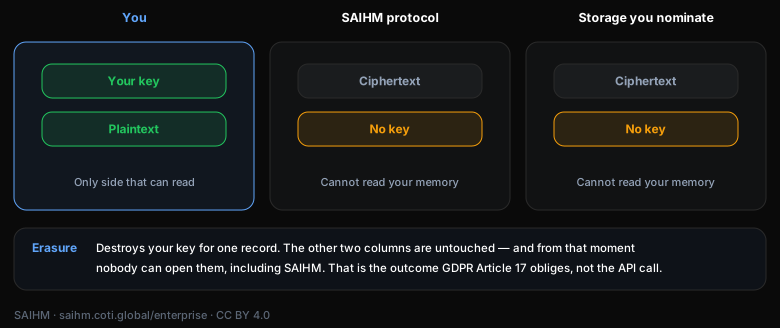
The difference is not a feature list. It is which party holds the key — and therefore which party can read your memory, or prove it is gone.
This diagram is CC BY 4.0 — reproduce or adapt it, commercially or otherwise, with attribution. Download the SVG; the license travels inside the file. Credit as: Who holds what, under SAIHM by SAIHM, CC BY 4.0.
Common questions
- Is SAIHM built for regulatory compliance?
- Yes, by design rather than as an add-on. The controls regulators and security leaders ask for are core SAIHM mechanisms that are live today: user-held encryption keys, provable cryptographic erasure (GDPR Article 17), and a tamper-evident on-chain audit trail. These map to GDPR, CCPA/CPRA, HIPAA, ISO/IEC 27001 and SOC 2, as well as the AI-specific frameworks now taking shape such as the EU AI Act, the NIST AI Risk Management Framework and ISO/IEC 42001.
- Who holds the encryption key for SAIHM memory?
- The user does. A SAIHM cell is encrypted under its own per-cell key, sealed to the user's own wallet, so control sits with the user or their organization rather than the operator. The operator cannot read what it cannot decrypt.
- Can SAIHM prove that a memory was deleted?
- Yes. SAIHM erasure destroys the key that decrypted the cell, which leaves the stored ciphertext mathematically unreadable, and anchors the destruction event on a public chain so it can be independently verified. A database delete only flags a row and leaves recoverable copies in backups and replicas.
- Does SAIHM memory move between different AI tools?
- Yes. SAIHM is one open memory protocol that speaks the Model Context Protocol, so the same memory works across AI clients instead of being rebuilt separately for each vendor.
- Do I need separate stores for different kinds of AI memory with SAIHM?
- No. A SAIHM cell is polymorphous: it stores content once and the AI agent decides the shape at recall time, so one encrypted unit replaces the usual stack of a vector database, key-value store, document store, and event log.
- Does SAIHM reduce what AI memory costs to run?
- Yes. Most AI memory rides inside the conversation, so every reply re-reads the whole history and the bill grows with the length of the work rather than its value. SAIHM keeps durable facts as separate encrypted cells and recalls only the few each step needs, so the context an AI carries each turn stays small. On long, multi-session work an open, reproducible benchmark measures about 79 percent fewer context tokens at ten turns, rising to about 85.9 percent by eighteen, and you can run it on your own session.
Independence notice. SAIHM is an Apache-2.0 protocol authored independently. It is not affiliated with OpenAI, Anthropic, Google, Perplexity, or any AI client vendor. Comparisons describe how memory tools are commonly built and will vary by specific product and configuration; evaluate any vendor, including SAIHM, against your own requirements. Pricing and tier details are on /pricing.