Polymorphous cells: one memory shape for every AI workload
· SAIHM · ~7 min read
Almost every other AI memory stack forces you to pick a shape per store. A vector database for semantic recall. A key-value store for facts. A document store for prose. An episodic log for transcripts. Maybe a graph store for entities. Each shape is a separate piece of infrastructure, a separate encryption posture, a separate audit trail, and a separate bill.
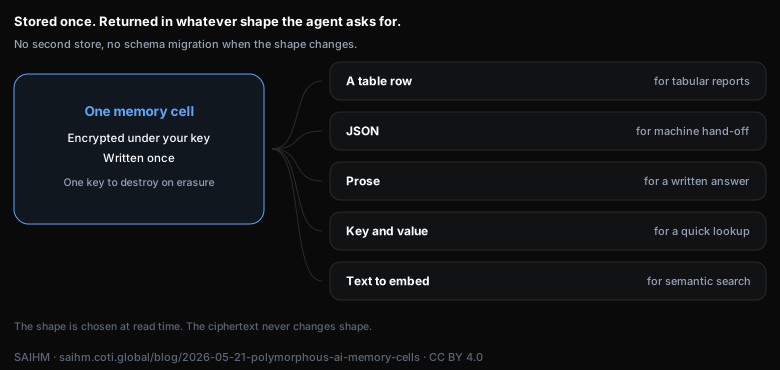
SAIHM does not work that way. A SAIHM cell is polymorphous: it holds one AI memory in one encrypted unit, and your AI Agent decides at recall time whether to return it as prose, a table, a JSON object, a single fact, a summary, or anything else the moment calls for. The cell does not commit to a shape. The recall does.
This post explains what that means in practice, why it collapses four or five stores into one, and the prompts you can paste into any AI you already use to start saving and recalling polymorphous memory today.
1. The shape problem that polymorphous SAIHM cells solve
AI agents need memory in many shapes. Today's stacks ask you to commit to a shape before you know what the agent will need.
A real AI Agent, doing real work, accumulates memory in at least six recognizable shapes:
- Episodic — "we talked about X yesterday."
- Semantic — "X is a kind of Y."
- Structured — tables, records, key-value facts.
- Procedural — "to do X, the sequence is A, then B, then C."
- Decisional — "we chose X because Y; revisit if Z."
- Transcript — the literal text of an exchange the Agent may want to quote later.
The standard reaction is to buy or build a store for each shape: a vector DB for semantic and episodic, a relational store for structured, a document store for transcripts and decisions, plus a procedural-pattern catalog the AI Agent has to know how to query separately. Five products, five keys, five audit posters, five reasons your AI Agent's memory architecture diagram has more boxes than the rest of your application.
The hidden cost is even worse than the headcount. The Agent must know which store to query for which shape. The instant a fact lives in the wrong store, recall fails silently. The instant a new shape is needed, an integration project starts. The Agent's memory becomes the most fragile part of the system.
2. What a polymorphous SAIHM cell actually is
One encrypted unit. One protocol. Many possible recall shapes.
A SAIHM cell is the protocol's atomic unit of memory. It holds:
- The content — whatever you (or your AI Agent) chose to save, in whatever form was natural at save time. Prose, JSON, a CSV snippet, a paragraph, a fact, a transcript excerpt, a procedure.
- A small metadata envelope — tags, scope, timestamps, the authoring wallet identity.
- An encrypted wrapper — the content sealed under the cell's own per-cell key, which only the writing wallet can unwrap.
That is the whole cell. There is no schema, no fixed field set, no embedding vector you have to compute at write time, no shape commitment.
At recall, the AI Agent asks SAIHM for cells matching a query and a scope. SAIHM returns the matching cells. The Agent then decides what shape to deliver to the human (or the next step in the workflow). The same cell that came back to one query as a paragraph can come back to another query as a JSON object, or a single fact, or a row of a table.
The polymorphism is at recall time, not write time
This is the key idea. Other stacks bake the shape into the write — once you put something in a vector DB, that is what it is. Once you write a row in a relational store, the columns are fixed. SAIHM never commits the cell to a shape. The shape happens when an AI Agent reads the cell and renders it for whatever the moment needs.
3. Examples: one cell, many shapes
Read these as prompts you can paste straight into any AI client connected to SAIHM.
Save once as prose — recall as JSON
Save to SAIHM: the production deploy on 2026-05-20 rolled back
because the migration locked the orders table for 90 seconds.
The fix was to switch to an online schema change tool.
Later that week, an AI Agent that needs the same information as a structured record asks:
Use SAIHM to recall the 2026-05-20 deploy event,
return it as a JSON record with fields:
date, what_happened, root_cause, fix.
The same cell now arrives as:
{
  "date": "2026-05-20",
  "what_happened": "production deploy rolled back",
  "root_cause": "migration locked orders table for 90 seconds",
  "fix": "switch to online schema change tool"
}
No second write. No schema migration. No re-ingest. The recall shapes the output.
Save once as a table — recall as a summary
Save to SAIHM as structured data: a table of our quarterly
support-ticket counts for each region for the last four quarters.
Six weeks later, the same Agent (or a different Agent that holds a SAIHM share to the same scope) asks:
Use SAIHM to summarize the regional support-ticket trend
across the last four quarters in two sentences.
The cell that came in as a table comes back as a paragraph. One memory, two shapes, one source of truth.
Save once as a decision — recall as a procedural sequence
Save to SAIHM: we chose Postgres for the new analytics service
because we already have an oncall rotation for it,
and the read pattern is moderate volume.
Revisit if write volume crosses 10x current.
Later, when another Agent is bootstrapping a similar service:
Use SAIHM to recall our analytics-service database choice
as a procedural checklist for the next service we set up.
The decision cell renders as a sequence of steps that the second Agent can follow — including the revisit trigger as an explicit final check.
4. What polymorphous cells let you stop doing
SAIHM is synonymous with simplicity. Here is what you no longer have to operate.
- Per-shape stores. No separate vector DB to run. No separate KV store. No separate document store. No separate episodic log. SAIHM is one protocol holding all shapes.
- Per-shape encryption postures. SAIHM encrypts every cell at write time under its own per-cell key, which only your wallet can unwrap, before it ever leaves the AI client. Whether the cell holds a paragraph or a table, the encryption is the same and lives in one place.
- Per-shape audit trails. Every SAIHM operation — write, recall, forget, share — emits a tamper-evident receipt anchored on a public chain. One audit posture for every memory shape.
- Schema-migration projects. SAIHM has no schema to migrate. A new fact, a new field, a new shape is a recall-time concern.
- Agent routing logic. Your AI Agent does not have to choose between five stores. It calls SAIHM. SAIHM returns the matching cells. The Agent shapes the answer.
The measured outcome — around 85% fewer context tokens on long sessions (reproducible with the open benchmark) — comes from collapsing this kind of moving-part count. Polymorphous cells are a large part of the why.
5. The compliance bonus: one cell, one erasure
When you delete an AI memory, you have to delete it everywhere. Polymorphous cells make "everywhere" mean one place.
Right-to-erasure obligations (GDPR Article 17, equivalents in HIPAA, PIPL, PIPEDA) require that personal data be removed on request — from every store, every backup, every embedding, every cache. The traditional shape-per-store architecture turns that into a multi-product engineering ticket: the vector DB has to lose its embedding, the KV store has to drop the record, the doc store has to delete the file, every backup that ever rolled has to be re-spun.
A SAIHM cell lives in one protocol. One cell, one erasure. The erasure itself is cryptographic: SAIHM destroys the key that decrypted the cell, then anchors the destruction event on a public chain. The ciphertext remains on the storage network as unreadable bytes that nobody — including SAIHM — can ever decrypt again. That is what makes the erasure defensible under a strict reading of GDPR Article 17, and you can independently verify it on a public block explorer.
Use SAIHM to forget the cell tagged {sensitive-topic}.
Prove it is gone.
6. Three prompts to start using polymorphous cells today
Paste these into the AI client you already use. The SAIHM protocol is the same in Claude Code, Claude Desktop, Cursor, Continue, ChatGPT (via an MCP bridge), and any other Model Context Protocol client.
Prompt 1: save a fact in whatever shape is natural
Save this to SAIHM, in whatever shape captures it best.
Add the tag {project-name}.
Prompt 2: recall it in a different shape
Use SAIHM to recall the cells tagged {project-name}
and return the answer as {a JSON record | a table | a one-sentence summary | a procedural checklist}.
Prompt 3: reshape on the fly across a workflow
For each SAIHM cell tagged {project-name},
return it as a structured row I can append to a tracker.
Then summarize the whole set in two sentences.
You can mix shapes in a single recall, change shapes between recalls, and never re-write a cell. The cell is the durable thing. The shape is a render.
7. Join SAIHM and try polymorphous cells in your own AI
If your current AI memory architecture has five boxes, polymorphous SAIHM cells collapse them into one. The fastest way to feel the difference is to try it on a real workload.
- Join SAIHM at /join. Enrolment is a few clicks. PAYG and paid tiers available; see /pricing.
- Connect your AI client to the SAIHM endpoint — one block of configuration, copy-paste from the quickstart page.
- Paste the three prompts above. Save a fact one way. Recall it another way. Then a third way. Polymorphism is most convincing when you see it in your own workflow.
One protocol. One encryption posture. One audit trail. Every memory shape your AI Agent needs. Join SAIHM and see it for yourself.
Still have questions? The SAIHM chatbot is on every page (bottom-right). Ask it anything about polymorphous cells, recall, encryption, sharing, compliance, or pricing — you will get an immediate answer.
Try it: a drop-in memory contract
Here is the fastest way to feel the difference. Paste this into your agent’s system prompt — it assumes the SAIHM MCP tools saihm_recall / saihm_remember / saihm_forget are wired into your harness. Following it is what produces the savings:
## Memory contract

On every turn, before you act:
1. RECALL, don't re-read. Call saihm_recall with keywords for the task to load a small, bounded set
   of cells. Do NOT re-send prior turns - the recalled cells ARE your context.
2. Prefer the CURRENT fact. If two recalled cells conflict, the most recent /
   non-superseded one wins - never act on a decision a later cell reversed.
3. REMEMBER durably. Call saihm_remember to persist decisions, conventions,
   and constraints as cells - one fact each, in your own words.
4. On a "delete my data" request, call saihm_forget on those cells: erasure
   is per-record and provable, not a soft delete.
Bounded recall flattens the resend curve from O(N²) to O(N·cap) — the 62.8–85.9% fewer context tokens the open benchmark shows. Start with a small recall cap and raise it only if recall misses.
One write, one key, one thing to erase. The shape is a read-time decision, which is why adding a new shape never becomes a migration.
This diagram is CC BY 4.0 — reproduce or adapt it, commercially or otherwise, with attribution. Download the SVG; the license travels inside the file. Credit as: One encrypted cell, returned in whatever shape you ask for by SAIHM, CC BY 4.0.
Common questions
- What is a polymorphous AI memory cell?
- A polymorphous cell stores an AI memory once, in one encrypted unit, and lets the AI Agent decide at recall time whether to return it as prose, JSON, a table, a list, a single fact, or a summary. The cell does not commit to a shape; the recall does.
- Why is polymorphous memory better than separate vector, KV, and document stores?
- A separate store per shape multiplies your operational cost: separate keys, separate encryption posture, separate audit trail, separate billing, separate failure modes. Polymorphous cells collapse those into one protocol with one prompt vocabulary. The AI Agent calls SAIHM the same way regardless of whether the answer comes back as a paragraph or a record.
- Do SAIHM polymorphous cells need a schema migration when the data shape changes?
- No. SAIHM cells store the content and a small metadata envelope. When you save a fact and later want it back as JSON, ask the AI to format it that way at recall. There is no schema to migrate, no table to alter, no embedding model to re-run.
- Is SAIHM encrypted at rest?
- Yes. Every SAIHM cell is encrypted at write time under its own per-cell key, sealed so that only your wallet can unlock it, then sharded across the decentralized storage tier. Only your AI Agent (with your wallet) can decrypt. SAIHM the operator cannot read the cell contents.
Independence notice. SAIHM is an Apache-2.0 protocol authored independently. It is not affiliated with OpenAI, Anthropic, Google, Perplexity, or any AI client vendor. The context-token reduction (around 85% on long sessions) is reproducible independently with the open benchmark, and varies by usage pattern. Pricing and tier details are on /pricing.