Your AI agent, with a memory that is yours.
SAIHM — Sovereign AI Horizontal Memory. A sovereign, encrypted, sharable, persistent memory protocol for AI agents.
The memory layer for businesses and regulated enterprises — and the developers shipping to them. Retail tools remember; SAIHM can prove what it remembers, shares, and erases.
Short answer
SAIHM is persistent memory for AI agents in which you hold the encryption key. Your agent’s memories are encrypted before they leave your device, kept across sessions, apps and vendor switches, shared only when you grant access, and erased by destroying the key rather than by deleting a row. It is Apache 2.0 and free to start.
Any agent that speaks MCP can join with one command. Claude Code, Cursor, or something you built yourself:
npx -y @saihm/mcp-server-pro free-joinNo card, no wallet, no configuration. The same command serves the free tier and every paid tier — upgrading changes your plan, not your setup. Full quickstart →
For you
Tell your agent “Join SAIHM.” Start free — no card, no crypto. No technical setup.
For developers
One protocol your agent already speaks. Apache-2.0, with MCP, LangChain and LlamaIndex adapters.
For enterprise
Regulatory-ready: portable, auditable, with right-to-erasure on demand.
For government
Sovereign data trail. Public-protocol auditability. No vendor lock-in.
What SAIHM is for
Today’s AI agents forget. Or worse, they remember on someone else’s server, under someone else’s rules. SAIHM gives any AI agent — commercial or open-source — a memory layer the user actually owns. Encrypted. Portable. Sharable when you choose. Erasable when you don’t.
- Sovereign. The user holds the keys, not the agent vendor.
- Encrypted. Every memory is sealed before it leaves the device.
- Sharable. Grant access to a teammate, an auditor, or another agent — revoke it whenever.
- Persistent. Memory survives the conversation, the app upgrade, the vendor switch.
For any AI agent, anywhere
SAIHM is not an AI agent. It is the memory layer that any AI agent can talk to — commercial assistants, open-source agents, or anything you build yourself. If your agent speaks the standard agent protocol, it speaks SAIHM.
See it run
Runnable demos ground a memory you own in every major model — Claude, GPT, DeepSeek, Qwen, Kimi, GLM — then prove you can erase it. Each runs offline in about a minute; no account needed to try it. There are drop-in adapters for LangChain and LlamaIndex, and an MCP server for Claude Code and Cursor.
Measured: ~85% fewer context tokens on long sessions
Most AI agents re-send their entire transcript every turn, so the context you pay for grows quadratically as a session runs — and eventually overflows the context window. SAIHM recalls a small, bounded set of memory cells instead. Across a realistic multi-session coding task, that cut input tokens by 62.8% to 85.9%, and the longer the session, the wider the gap.
| Session length | Re-send everything | SAIHM recall | Fewer tokens |
|---|---|---|---|
| 5 turns | 1,628 | 605 | 62.8% |
| 10 turns | 6,091 | 1,273 | 79.1% |
| 15 turns | 13,175 | 2,023 | 84.6% |
| 18 turns | 18,688 | 2,632 | 85.9% |
Input/context tokens only, summed across every turn (output tokens are identical under both strategies). Counted with the GPT-4 BPE tokenizer; runs fully offline and deterministic, so anyone reproduces the same result. It measures resend-vs-recall token volume, not any one provider’s bill.
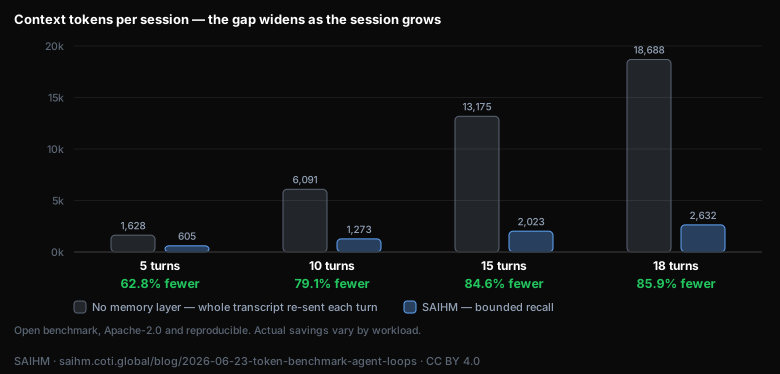
This chart is CC BY 4.0 — reproduce or adapt it, commercially or otherwise, with attribution. Download the SVG; the license travels inside the file. Credit as: Context tokens per session: no memory layer versus SAIHM by SAIHM, CC BY 4.0.
Verifiable, not asserted
Anchor provenance: chain 2632500, block 7,024,653.
Common questions
- What is SAIHM?
- SAIHM is a persistent memory protocol for AI agents in which the user holds the encryption key. Memories are encrypted before they leave the device, survive across sessions and vendor switches, are shared only on explicit grant, and are erased by destroying the key. It is Apache-2.0 licensed.
- How do I give my AI agent persistent memory?
- Run
npx -y @saihm/mcp-server-pro free-join. Any agent that speaks the Model Context Protocol — Claude Code, Cursor, or one you built — picks up eight memory tools from that point on. There is no card, wallet or configuration step, and the free tier needs no payment method. - Who can read memories stored with SAIHM?
- Only the holder of the key. Memory is encrypted on your device before it is stored, so the agent vendor, SAIHM itself and whichever node holds the encrypted copy all see ciphertext only.
- Can memory be deleted properly, for GDPR purposes?
- Yes. Erasure destroys the key that decrypts a memory rather than deleting a row, so copies, replicas and backups are left unreadable rather than merely unlisted. This is the mechanism behind a right-to-erasure request; see the Article 17 crosswalk for how it maps clause by clause.
- Does SAIHM cost anything to start?
- No. The free tier is free permanently and needs no payment method. Paid plans are monthly and settle by card through Stripe worldwide, or by card and M-PESA through Paystack in Africa; see pricing.
Understand agent memory
Six pages on how agent memory actually works, written to be useful whether or not you ever use SAIHM. Each one is explicit about where the limits are.
- AI agent memory — the four kinds, who can technically read each one, and what erasure has to mean.
- MCP memory — what the Model Context Protocol standardizes, what it deliberately leaves open, and the one-line setup.
- Persistent memory — what memory has to survive: the session, the machine, the app, the model, the provider.
- Multi-agent memory — agents, swarms and robot fleets coordinating without being wired to each other.
- Memory security — the threat model, including the parts encryption does not fix.
- Memory protocol — why portability is a property of the protocol layer, not a product feature.
Comparing options? The decision matrix states where the answer is not SAIHM.
Get started
Pick the audience page that fits you. Each one tells you, in plain language, what to do next.
- /individuals — for everyday users
- /developers — for builders and integrators
- /enterprise — for compliance-sensitive organizations
- /government — for public-sector deployments