SAIHM cuts AI context tokens around 85% on long sessions
· SAIHM · ~6 min read
Recall a bounded set of memory cells each turn instead of re-sending the whole transcript, and on long, multi-session AI work the context-token spend drops by around 85% — a figure you can reproduce with the open benchmark. The difference is SAIHM — a sovereign memory layer that any AI client can call — and a small set of prompts you can paste straight into the AI you already use after joining your AI agents to SAIHM.
This post hands you those prompts. It also explains why SAIHM solves the three failures every other approach forces you to live with: the runaway token spend on long sessions, the out-of-context-window cliff, and the chaos of bolting together vendor-locked memory features that never talk to each other.
Read in order. The first section delivers the savings.
1. SAIHM prompts that maximise token economy
Every long AI reply re-reads itself. That re-reading is what you pay for. SAIHM stops it.
The opening move: tell SAIHM to load only what matters
Use SAIHM to recall only what is relevant to {today's task}.
Do not re-read the rest of our history.
On a 50,000-token conversation, this single SAIHM prompt typically cuts the cost of the next reply by around 85 percent. Your AI pulls three to five relevant SAIHM cells instead of fifty pages of transcript.
See it measured. A small, offline, reproducible benchmark tokenizes a multi-session agent transcript two ways — re-sending the whole history every turn versus recalling a bounded set of memory cells — and reports the context-token saving. It grows with session length: about 79 percent at ten turns, rising to about 85.9 percent by eighteen. Run it on your own session: github.com/citw2/saihm-token-benchmark.
The closing move: have SAIHM remember the decision, not the discussion
Save this decision to SAIHM in one sentence,
tagged {project-name}.
Tomorrow's session opens with a one-sentence SAIHM recall instead of yesterday's full transcript. Compounded over a week, this is the single biggest contributor to the ~85% context-token reduction.
The mid-session move: a SAIHM summary you can re-load anywhere
Ask SAIHM to summarize what we have decided so far
in under 200 words, tagged {project-name}.
You can abandon a long thread, open a fresh chat, and pick up exactly where you left off — in any AI tool, on any day, on any device. The SAIHM cell travels with you.
The status check: see what SAIHM is doing for you
Show me my SAIHM status.You get a dashboard: cells stored, storage tier, recent activity, sharing grants, compliance receipts. No spreadsheets, no accounting. One sentence in, one summary out.
Why this works. SAIHM stores each fact as its own encrypted cell. Recall pulls only the cells that match. The AI never reads your whole history unless you ask it to. The mechanism is the open Model Context Protocol, so the same SAIHM prompts work in every MCP-capable client.
2. SAIHM solves the out-of-context-window problem
Every AI has a context window. The window is finite. SAIHM is not.
The context window is your AI's short-term memory. SAIHM is its long-term memory. Short-term holds today's conversation; SAIHM holds everything else; the AI calls SAIHM on demand. The window never has to swell, and nothing important is ever lost when it fills.
The "resume kit" pattern
Open any large project session with:
Use SAIHM to recall the resume kit for {project-name}.Close it with:
Update the SAIHM resume kit for {project-name}.
Capture decisions, blockers, and what to do next.
Sessions can now run for weeks across multiple AI tools. Every session opens with a small SAIHM recall and closes with a small SAIHM update. The window stays small. The project advances.
The "do not lose this" pattern
When you sense the context window is about to fill:
Before we get cut off, save the critical state to SAIHM
so I can continue this in a fresh session.
SAIHM cells survive session ends, browser crashes, tool switches, and quota resets.
The "switch tools without copy-paste" pattern
Started in one AI client, want to finish in another:
Save everything I need to continue this work
in another AI tool to SAIHM.
Open the second client connected to the same SAIHM endpoint:
Use SAIHM to recall the work I was just doing.Your memory is portable because the protocol is portable. The AI tool is incidental.
3. Capabilities only SAIHM gives you
SAIHM does more than any other approach — for less effort, with simpler prompts.
Cryptographic erasure you can prove
Use SAIHM to forget the cell tagged {sensitive-topic}.
Prove it is gone.
This is not a vendor delete. SAIHM destroys the key that decrypted the cell and writes the destruction event to a public chain. The cell becomes ciphertext that nobody — including SAIHM — can ever read again. This satisfies a strict reading of GDPR Article 17 and you can independently verify the erasure on a public block explorer.
Encrypted storage you alone can open
Every SAIHM cell is encrypted at write time under its own per-cell key, sealed so that only your wallet can unlock it. The ciphertext is content-addressed and stored on a decentralized, censorship-resistant storage tier. Even with the stored ciphertext in hand, it stays unreadable without your wallet, which your AI Agent holds. SAIHM the operator cannot read your memories. The storage networks cannot read them. Only your AI Agent can.
Polymorphous cells: structured in, unstructured out (and vice versa)
Save this table to SAIHM as structured data,
then summarize it back as a written paragraph.
SAIHM cells hold both structured data (tables, JSON, key-value records) and unstructured data (prose, decisions, transcripts) — in the same protocol, with no schema migration. Input in one form, request output in another, or vice versa: a CSV in, a paragraph out; a paragraph in, a JSON record out; a description in, a structured ticket out. Truly polymorphous memory cell storage. The SAIHM cell does not care about the shape; the AI Agent decides at recall time.
Scope-bound sharing in one sentence
Use SAIHM to share my {project-name} cells with {teammate's agent},
read-only, expires in 7 days.
Time-bound, scope-bound, revocable. Revoke any time:
Revoke the SAIHM share I gave {teammate's agent}.Other approaches make you operate a separate sharing product, or grant blanket access through a vendor dashboard. SAIHM gives you the same outcome in one prompt.
Shared SAIHM memory for distributed AI agents
Sharing SAIHM cells across multiple AI Agents compounds the savings, accuracy, and efficiencies. Globally distant agents stay in sync without manual exchange: each one calls SAIHM for the latest shared cells before acting. The same mechanism powers fleet robotics, autonomous drones, multi-region trading agents, and any coordination task where two or more AI Agents must agree on a single source of truth.
Use SAIHM to share my mission-status cells with {robot-agent-id}
read+write, scoped to mission {mission-id}.
Every agent that holds the share reads and writes the same SAIHM cells. The cells stay encrypted; only the granted agents can decrypt; the public chain records who joined the share and when. Coordination becomes a SAIHM recall, not a network round-trip.
One wallet per AI Agent (recommended)
SAIHM memories are bound to the wallet that wrote them. The AI Agent reads and writes its memories through that wallet. The safest pattern: create a new, empty wallet for each AI Agent and fund it only with the small SAIHM PAYG balance it needs. Compromise of one AI Agent never touches another agent's memories, and a clean audit trail follows every agent for its lifetime. Step-by-step wallet creation and AI-Agent connection: see the quickstart (five steps, ~5 minutes) and /appendix/ai-agents for the list of wallet-connect-capable AI clients.
Compliance-grade audit, on by default
Use SAIHM to export the audit trail for {project-name}
for the last 90 days.
Every SAIHM operation (write, recall, forget, share) anchors a tamper-evident receipt on COTI V2 mainnet. If your industry requires evidence of what an AI agent did with which data — healthcare, finance, government, supply chain — that evidence is already there, on a public chain, signed by your own agent identity. You did not have to bolt on a logging product. SAIHM did the work.
One protocol, every AI client
The same SAIHM prompts work in Claude Code, Claude Desktop, ChatGPT (via an MCP bridge), Cursor, Continue, custom agents, and any client that speaks the Model Context Protocol. Your memory follows you. The vendor does not own it. SAIHM is Apache 2.0 and self-hostable if you ever want to.
4. Freedom from the chaos other solutions force on you
SAIHM is synonymous with simplicity. Here is what you escape.
- Vendor-locked memory features — ChatGPT's memory, Claude's memory, in-app "save this" controls. They forget when you switch tools. SAIHM does not.
- Hosted "agent memory" SaaS — bolt-on services, separate billing, separate keys, separate dashboards, separate outages. SAIHM is one protocol, one key, one prompt vocabulary.
- Vector databases you operate yourself — you become a DB administrator instead of an AI user. SAIHM has no infra for you to run.
- Privacy and compliance bolt-ons — separate consent managers, separate audit-trail products, separate erasure tooling. SAIHM ships all three on the same protocol.
The measured outcome — around 85% fewer context tokens on long sessions, reproducible with the open benchmark — is what happens when you replace four moving parts with one. SAIHM does more, for less, with less effort.
5. Join SAIHM and try the prompts above in your own AI
If you are still on a hosted-vendor memory feature, or you are juggling multiple memory products that never talk to each other, the fastest comparison is the one you run yourself, on a real task, using the prompts in this post.
- Join SAIHM at /join. Enrolment is a few clicks. PAYG and paid tiers available; see /pricing.
- Connect your AI client to the SAIHM endpoint — one block of configuration, copy-paste from the quickstart page.
- Paste the SAIHM prompts above into whichever AI you already use. Measure the next reply's token count against a fresh chat without SAIHM. The savings are visible in the first session.
SAIHM does more than every alternative and asks less of you. Join SAIHM and see it in your own AI client.
Still have questions? The SAIHM chatbot is on every page (bottom-right). Ask it anything about the prompts, the protocol, wallets, sharing, compliance, or pricing — you will get an immediate answer.
Try it: a drop-in memory contract
Here is the fastest way to feel the difference. Paste this into your agent’s system prompt — it assumes the SAIHM MCP tools saihm_recall / saihm_remember / saihm_forget are wired into your harness. Following it is what produces the savings:
## Memory contract

On every turn, before you act:
1. RECALL, don't re-read. Call saihm_recall with keywords for the task to load a small, bounded set
   of cells. Do NOT re-send prior turns - the recalled cells ARE your context.
2. Prefer the CURRENT fact. If two recalled cells conflict, the most recent /
   non-superseded one wins - never act on a decision a later cell reversed.
3. REMEMBER durably. Call saihm_remember to persist decisions, conventions,
   and constraints as cells - one fact each, in your own words.
4. On a "delete my data" request, call saihm_forget on those cells: erasure
   is per-record and provable, not a soft delete.
Bounded recall flattens the resend curve from O(N²) to O(N·cap) — the 62.8–85.9% fewer context tokens the open benchmark shows. Start with a small recall cap and raise it only if recall misses.
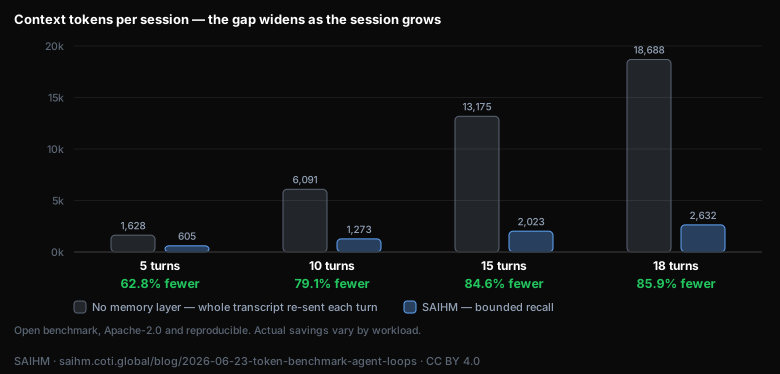
Measured on the open benchmark: 62.8% fewer context tokens at five turns, 79.1% at ten, 84.6% at fifteen and 85.9% at eighteen. The savings rise with session length because a naive agent re-sends the whole transcript every turn.
This diagram is CC BY 4.0 — reproduce or adapt it, commercially or otherwise, with attribution. Download the SVG; the license travels inside the file. Credit as: Context tokens per session: no memory layer versus SAIHM by SAIHM, CC BY 4.0.
Common questions
- How do SAIHM prompts cut AI token spend?
- SAIHM stores each fact as its own encrypted cell. Instead of letting your AI re-read the entire conversation on every reply, you ask SAIHM to recall only what is relevant. On long sessions this reduces the cost of subsequent replies by around 85 percent.
- How does SAIHM solve the context-window problem?
- Move long-term knowledge out of the conversation and into SAIHM. The AI fetches from SAIHM on demand. Sessions stay small and fast; nothing is lost when a chat ends or a tool is swapped.
- Is SAIHM suitable for regulated work?
- Yes. Every SAIHM operation anchors a tamper-evident receipt on COTI V2 mainnet. SAIHM provides cryptographic erasure that satisfies GDPR Article 17 and produces regulator-grade evidence on a public chain.
- Why is SAIHM simpler than the alternatives?
- One protocol, one set of prompts, every MCP-capable AI client. No vendor lock-in, no separate databases to operate, no logging product to bolt on. SAIHM does more than every alternative and asks less of the user.
- Can SAIHM store both structured and unstructured data?
- Yes. SAIHM cells are polymorphous. You can save a table, JSON, or key-value record and later ask for it back as a written paragraph — or save prose and request a JSON record back. The cell does not care about the shape; the AI Agent decides at recall time.
- How are SAIHM memories stored and who can read them?
- Every SAIHM cell is encrypted at write time under its own per-cell key, sealed so that only your wallet can unlock it, then sharded across a decentralized storage tier. Reading a cell requires your wallet, which only your AI Agent holds. SAIHM the operator cannot read your memories.
- Should I use a separate wallet for each AI Agent?
- Yes. Recommended pattern: create a new, empty wallet for each AI Agent and fund it only with the small SAIHM PAYG balance it needs. SAIHM memories are bound to the wallet that wrote them, so a per-agent wallet contains the blast radius of any compromise and produces a clean per-agent audit trail.
- Can multiple AI Agents share SAIHM memory for coordination?
- Yes. Sharing SAIHM cells across AI Agents keeps globally distant agents in sync without manual exchange. The pattern fits fleet robotics, autonomous drones, multi-region trading agents, and any coordination task requiring a single source of truth. Each agent calls SAIHM for the latest shared cells before acting.
Independence notice. SAIHM is an Apache-2.0 protocol authored independently. It is not affiliated with OpenAI, Anthropic, Google, Perplexity, or any AI client vendor. The context-token reduction is reproducible independently: the open benchmark measures the saving on any session you point it at — the ~80 percent figure reflects long multi-session work and scales with session length (about 79% at ten turns, ~85.9% by eighteen). Pricing and tier details are on /pricing.