Cryptographic erasure: how SAIHM makes AI memory forget for real
· SAIHM · ~8 min read
AI agents are now persistent. They remember conversations, decisions, personal facts, regulated content, and procedural state across days, tools, and tenants. Every regulatory regime that already governs data — GDPR Article 17, HIPAA, PIPL, PIPEDA, the EU AI Act — applies to that memory. When a person, a regulator, or an internal policy demands "delete what the agent remembers about me," the answer cannot be "we tried."
This post explains why a database DELETE is not erasure, what cryptographic erasure is, how SAIHM implements it for AI memory, and how a regulator can verify a single erasure on a public block explorer without any cooperation from SAIHM. There are also three prompts you can paste into the AI client you already use to perform a forget today and pull the audit receipt.
1. Why DELETE is not erasure
A regulator asking "prove that data is gone" rarely accepts "we ran DELETE."
A DELETE statement in a relational database does one specific thing: it marks a row in the live table as removed. It does not, in any modern operational deployment, actually erase the bytes from every place the row has been. Bytes survive in:
- Write-ahead logs — the row's full prior value sits there until the WAL segment ages out, sometimes weeks.
- Point-in-time backups — daily, weekly, monthly snapshots that may retain the row for years under standard backup policy.
- Read replicas — lagging copies, sometimes geographically dispersed, sometimes operated by a different team.
- Snapshot volumes — cloud-provider block-level snapshots, often kept for disaster recovery.
- Vector embeddings — AI workflows commonly embed the row's content into a separate vector store. That embedding is derivative personal data and is its own forgetting problem.
- Downstream sinks — anything the row was streamed into: an analytics warehouse, a search index, a log aggregator, a fraud detection pipeline, an AI agent's own memory.
Each of those locations is an independent erasure problem. The "delete it everywhere" engineering ticket grows with every downstream system. The traditional answer is a multi-quarter project to track lineage, instrument every sink, and prove eventual consistency. Meanwhile the regulator is waiting and the clock is running.
AI memory layers make this worse, not better. An AI agent writes derived facts from the original data into its own memory store. That memory is now its own copy of regulated content, often under a different access posture than the source. Standard DELETE on the source does nothing about the agent's memory of it.
2. What cryptographic erasure actually is
Destroy the key, not the bytes.
Cryptographic erasure — sometimes called crypto-shredding — flips the problem. Instead of trying to delete every copy of the bytes, you encrypt the bytes under a key, hold that key in a single revocable location, and when you want to "forget," you destroy the key.
The ciphertext can remain wherever it has been replicated — backups, snapshots, distributed storage networks, archive tier. Without the key, every copy is mathematically random bytes. There is nothing to recover. The data has been erased in the only sense that matters: it is no longer accessible by anyone, anywhere, ever.
The pattern is recognized in standards: NIST SP 800-88r1 ("Guidelines for Media Sanitization") explicitly treats destruction of the encryption key as a valid sanitization technique for encrypted media. Several national regulators take a similar position for personal-data erasure under GDPR Article 17 when (a) the encryption was strong, (b) the key was uniquely tied to that data, and (c) the destruction is auditable.
Those three conditions are precisely what SAIHM enforces by design.
3. How SAIHM implements cryptographic erasure for AI memory
Per-cell key. Real destruction. Tamper-evident receipt on a public chain.
Every SAIHM cell is encrypted at write time under its own data-encryption key (DEK) — a unique, randomly generated key, never reused and never derived from anything else, so it cannot be recomputed once it is destroyed. That DEK is then wrapped (encrypted) under a key-wrapping key the client derives from the user's wallet through a post-quantum-aware key custody graph. The wrapped DEK is held only in erasable storage alongside the pointer to the cell — it is never written into the immutable ciphertext store. The plaintext DEK never leaves the AI client, and only the client — holding the wallet — can unwrap it to read the cell.
The ciphertext is sharded onto a public decentralized storage network. The SAIHM protocol holds only the encrypted metadata envelope that points at the cell. The storage operator cannot read the cell. SAIHM the protocol operator cannot read the cell. Only the AI Agent that holds the wallet can.
What a forget does
When you ask SAIHM to forget a cell, the wrapped data-encryption key — the only thing that can reconstruct that cell's random DEK — is destroyed, and any copy cached in the client is dropped. Because the DEK was random, once that wrapped copy is gone nothing can regenerate it: not the wallet, not SAIHM, not the storage network. SAIHM records this as a GDPR-Article-17 erasure, and the forgotten cell can no longer be returned to a recall.
A tamper-evident receipt of the erasure is anchored on the public chain (COTI V2). That receipt is the audit artifact a regulator will look at — independently verifiable on a public block explorer, without SAIHM's cooperation.
After the key is destroyed, the ciphertext bytes on the storage network may still exist — you cannot ask a storage network to retroactively delete what it stored — but they are now permanently undecryptable by anyone. The cell has been erased in the cryptographic sense, with a publicly verifiable receipt.
Why per-cell DEKs matter
A single master key protecting every cell would mean "destroy one cell" requires re-encrypting every other cell under a new master — an enormous, slow, error-prone operation. SAIHM gives each cell its own DEK so a forget is a single, atomic key destruction. One cell out, the rest of your memory unaffected.
4. How a regulator verifies a SAIHM erasure
Without SAIHM's cooperation. On a public block explorer. In about a minute.
The on-chain receipt is the verification artifact. A regulator (or your own compliance team, or an independent auditor) takes the identity of the cell that was supposedly erased, opens a public block explorer for COTI V2 mainnet at public block explorer, and looks up its erasure receipt. Tamper-evidently, the receipt confirms:
- That an erasure was recorded for that cell.
- When it happened.
The verifier does not need access to SAIHM's servers. SAIHM cannot retroactively change the receipt; the chain is immutable for everyone. The verification works the same way for the data subject, for the controller, for the regulator, and for an independent auditor.
This is the contrast that matters under GDPR Article 17. A regulator who is handed a screenshot of "DELETE row 4928 OK" from an operations dashboard has to take the operator's word for everything: that the DELETE actually ran, that backups have aged out, that no replica still holds the row. A regulator who is handed an on-chain transaction hash for the erasure event does not have to take anyone's word for whether that event was recorded, or whether the record was altered afterwards: the receipt is tamper-evident and verifies independently. That the destroyed key leaves the ciphertext permanently unreadable follows from the design above.
5. Three prompts to perform a SAIHM forget today
Paste these into the AI client you already use. The SAIHM protocol is the same in Claude Code, Claude Desktop, Cursor, Continue, ChatGPT (via an MCP bridge), and any other Model Context Protocol client.
Prompt 1: forget a single cell with proof
Use SAIHM to forget the cell tagged {sensitive-topic}.
Prove it is gone and give me the on-chain receipt URL.
The AI Agent returns a block-explorer link directly to the erasure transaction.
Prompt 2: forget every cell matching a scope
Use SAIHM to forget every cell tagged {personal-data-of-subject-X}.
Confirm each erasure on chain and give me the audit summary.
Useful when a data-subject erasure request applies to multiple cells. Each cell gets its own DEK destruction and its own on-chain receipt; the summary lists them.
Prompt 3: export the audit trail for a period
Use SAIHM to export the audit trail for {project-name}
for the last 90 days, including every write, recall, share, and forget,
in a format suitable for a compliance review.
The export is signed by your AI Agent's wallet identity and includes the on-chain transaction hashes. Hand it to your auditor or attach it to a regulator response.
6. What this lets you stop doing
SAIHM is synonymous with simplicity. Here is what you no longer have to operate or budget for.
- Erasure-tracking products. No separate lineage tracker, no separate consent manager bolt-on, no separate "right-to-be-forgotten" workflow product. SAIHM ships the forget as a first-class operation.
- Backup-window erasure timelines. No "your data will be fully erased once backups age out in 90 days." The DEK is destroyed at the moment of the forget; the backups become unreadable immediately.
- Vendor-trust assumptions. No "trust us, we deleted it." The on-chain receipt is the proof; it does not require trust in SAIHM or in any storage operator.
- Multi-system reconciliation. No "we have to also delete this from the warehouse, the search index, the log aggregator, the embedding store." The cell lives in one protocol; the forget happens in one protocol.
- Regulator back-and-forth. The audit export carries on-chain receipts. The verification is one click in a public block explorer. The conversation ends.
7. Join SAIHM and run a forget on your own AI memory
If your current AI memory layer cannot answer "prove this is gone" with a verifiable receipt, that is a compliance gap waiting to surface. SAIHM closes it on day one.
- Join SAIHM at /join. Enrolment is a few clicks. PAYG and paid tiers available; see /pricing.
- Connect your AI client to the SAIHM endpoint — one block of configuration, copy-paste from the quickstart page.
- Run a forget. Save a test cell, then erase it with Prompt 1 above. Open the block explorer link. The receipt is there before the kettle boils.
For CISOs and compliance leads who want the full ten-requirement landscape, see also AI memory needs a standard. SAIHM is built to be it. — a longer board/RFP read.
Still have questions? The SAIHM chatbot is on every page (bottom-right). Ask it anything about cryptographic erasure, key destruction, regulator verification, or the audit export — you will get an immediate answer.
Try it: a drop-in memory contract
Here is the fastest way to feel the difference. Paste this into your agent’s system prompt — it assumes the SAIHM MCP tools saihm_recall / saihm_remember / saihm_forget are wired into your harness. Following it is what produces the savings:
## Memory contract

On every turn, before you act:
1. RECALL, don't re-read. Call saihm_recall with keywords for the task to load a small, bounded set
   of cells. Do NOT re-send prior turns - the recalled cells ARE your context.
2. Prefer the CURRENT fact. If two recalled cells conflict, the most recent /
   non-superseded one wins - never act on a decision a later cell reversed.
3. REMEMBER durably. Call saihm_remember to persist decisions, conventions,
   and constraints as cells - one fact each, in your own words.
4. On a "delete my data" request, call saihm_forget on those cells: erasure
   is per-record and provable, not a soft delete.
Bounded recall flattens the resend curve from O(N²) to O(N·cap) — the 62.8–85.9% fewer context tokens the open benchmark shows. Start with a small recall cap and raise it only if recall misses.
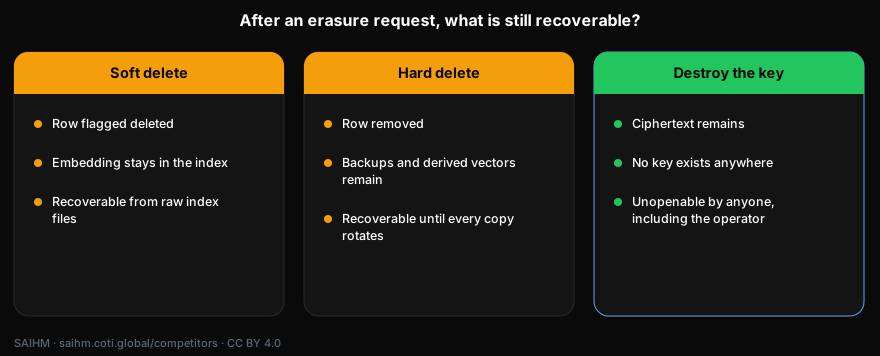
Soft delete leaves the embedding in the index. Hard delete leaves backups and derived vectors until every copy rotates. Destroying the key leaves ciphertext that no one can open, including the operator.
This diagram is CC BY 4.0 — reproduce or adapt it, commercially or otherwise, with attribution. Download the SVG; the license travels inside the file. Credit as: What survives three erasure mechanisms by SAIHM, CC BY 4.0.
Common questions
- What is cryptographic erasure?
- Cryptographic erasure (also called crypto-shredding) is destroying the encryption key that protects a piece of data, so the data ceases to be decryptable by anyone, anywhere it exists. The ciphertext can remain on disk, in backups, in replicas, or on a distributed storage network; without the key it is unreadable, indistinguishable from random bytes.
- Why is a regular database DELETE not enough?
- A DELETE statement marks a row for removal in the live table. It does not erase write-ahead logs, point-in-time backups, read replicas, snapshot copies, vector embeddings, or any downstream system the row was already streamed into. A regulator asking 'prove that data is gone' rarely accepts 'we ran DELETE and our backups will eventually expire.'
- How does SAIHM implement cryptographic erasure?
- Every SAIHM cell is encrypted at write time under its own per-cell data-encryption key (DEK), which only your wallet can unwrap. The forget operation destroys that key, so the ciphertext becomes permanently undecryptable, and anchors a tamper-evident erasure receipt on a public chain (COTI V2). The cell is now unreadable by anyone, including SAIHM, including the storage network.
- Can a regulator independently verify a SAIHM erasure?
- Yes. The destruction event is anchored on a public chain as a tamper-evident erasure receipt for that cell. The regulator opens the public block explorer, looks up the receipt, and confirms the erasure was recorded and when — without SAIHM's cooperation.
Independence notice. SAIHM is an Apache-2.0 protocol authored independently. It is not affiliated with OpenAI, Anthropic, Google, Perplexity, or any AI client vendor. This post describes the SAIHM erasure protocol as implemented; nothing in it constitutes legal advice on any particular regulatory regime. Organizations should validate erasure procedures against their own controllers and regulators. Pricing and tier details are on /pricing.