AI memory needs a standard. SAIHM is built to be it.
· SAIHM · ~7 min read · for CEO, CISO, and technical leadership
Your AI agents are already writing to memory. Some of what they write is regulated data, some is decision history, some is intellectual property. Every regime that covers data — GDPR, the EU AI Act, HIPAA, PIPL, PIPEDA — covers that memory the moment it is written. Today, most organizations are accumulating that memory across half a dozen incompatible vendor surfaces, with no shared way to audit it, erase it, or move it.
The market needs an AI memory standard. This post does three things. First, it lays out the honest current landscape. Second, it states the consensus requirements an AI memory standard must satisfy — derived from active regulation, established security frameworks, and the open protocols that are already winning in the AI tooling layer. Third, it makes the case that SAIHM is the most complete public candidate to be that standard, and shows how to evaluate the claim yourself.
Operating-cost case, disclosed up front: recalling a bounded memory set instead of re-sending the transcript cuts context-token spend by around 85% on long sessions — reproducible with the open benchmark. The compliance case is in this post.
1. The AI memory landscape today (honest read)
Four categories of solution dominate. None of the first three was designed to be a standard.
| Category | Examples | Who holds the key? | Cross-tool portable? | Erasure with proof? | Built-in audit trail? |
|---|---|---|---|---|---|
| Vendor-native memory features | OpenAI memories, Claude memory, Gemini personalisation, in-app "save this" | Vendor | No | No | No (vendor logs only) |
| Hosted memory SaaS | Mem0, Letta, Zep | Vendor (operator) | Limited (per integration) | No (delete is not erasure) | Partial |
| Self-operated vector databases | Pinecone, Weaviate, Chroma | You (but you operate the DB) | You build it | You build it | You build it |
| Open protocol AI memory | SAIHM | You (user-held wallet key) | Yes (Model Context Protocol) | Yes (cryptographic, on-chain receipt) | Yes (every operation, by default) |
Each of the first three categories ships real value — conversational continuity, hosted convenience, similarity search. None was designed to be the durable, regulator-defensible memory layer your AI agents will be operating in for the next decade. None offers all of: user-held keys, cross-tool portability, cryptographic erasure, and a tamper-evident audit trail. SAIHM does.
2. The consensus requirements an AI memory standard must meet
Ten requirements converge from active regulation, security frameworks, and the AI-tooling open protocols. They are not optional for any organization already covered by data law.
The sources of the consensus. The list below is the intersection of obligations and norms that practitioners are already operating against:
- GDPR Article 17 — right to erasure, including data held by automated decision systems.
- EU AI Act (Regulation 2024/1689) — logging, traceability, and human-oversight requirements for high-risk AI systems; phased application through 2027.
- NIST AI Risk Management Framework 1.0 (January 2023) — provenance, auditability, and incident-response expectations.
- ISO/IEC 27001:2022 — cryptographic key management, access control, and audit logging controls.
- HIPAA, PIPEDA, PIPL, LGPD — sectoral and regional privacy regimes with similar erasure and audit obligations.
- Model Context Protocol (open spec, multi-vendor adoption) — the de-facto interoperability surface for AI memory tools across Claude, ChatGPT bridges, Cursor, Continue, and custom agents.
- Operational reality — organizations running heterogeneous AI fleets need one memory layer across many clients to avoid an integration-and-audit explosion.
The ten requirements. Any AI memory layer that aspires to be a standard must satisfy all of them:
- User-held key custody. The encryption key sits with the data subject (or their organization), not the vendor. Vendors cannot read what they cannot decrypt.
- Cryptographic erasure with proof. A forget operation destroys the key, leaves the ciphertext mathematically unreadable, and produces an independently verifiable receipt — the GDPR-Article-17-defensible posture.
- Tamper-evident audit trail. Every write, recall, share, and erasure is logged to a surface neither operator nor user can silently rewrite. This is the regulator-facing artefact.
- Open standard, cross-tool portability. The same memory protocol works across every AI client an organization uses, today and after the next vendor change.
- Encryption at rest and in transit. Ciphertext-only storage; ciphertext-only egress. No plaintext at any node the user does not control.
- Polymorphous data shapes. Tables, JSON, key-value records, prose, transcripts, and binary references in one protocol. Input one shape, request another; the cell does not care.
- Revocable scope-bound sharing. Per-record sharing with time bounds, mode bounds, and one-prompt revocation. No blanket access.
- Distributed-agent coordination. Multiple AI agents — across regions, fleets, or supply chains — can share live memory state with cryptographic access control. Single source of truth without manual sync.
- One protocol, every client. A single integration surface for the whole AI fleet. Minimizes engineering cost, audit cost, and incident-response surface area.
- Independent verifiability. Open source, public-chain anchors, and reproducible builds. No "trust us" claims; every assertion is testable by a third party.
3. SAIHM, requirement by requirement
SAIHM is the only public AI memory protocol known to satisfy all ten requirements today. Each line below is independently verifiable.
| Requirement | SAIHM mechanism | How to verify it yourself |
|---|---|---|
| 1. User-held key custody | Post-quantum, wallet-derived identity keys; an HKDF identity chain anchored to the holder's wallet. SAIHM the operator never holds the user's decryption key. | Inspect the open-source key-derivation code; verify wallet ownership on COTI V2 mainnet. |
| 2. Cryptographic erasure with proof | Forget operation destroys the cell's Data Encryption Key, so the ciphertext becomes permanently undecryptable, and anchors a tamper-evident erasure receipt on the public chain. | Read the erasure receipt on public block explorer; the original ciphertext is mathematically unreadable. |
| 3. Tamper-evident audit trail | Every SAIHM operation anchors a signed receipt on COTI V2 mainnet (chain ID 2632500). Regulator-grade evidence by default. | Pull the audit-trail export from saihm_status; cross-check each receipt on the public explorer. |
| 4. Open standard, cross-tool portable | Eight MCP tools cover the whole protocol surface. Same prompts work in Claude Code, Claude Desktop, ChatGPT (via MCP bridge), Cursor, Continue, and custom agents. | Connect any MCP-capable client to the SAIHM endpoint; the same eight tools appear. |
| 5. Encryption at rest + in transit | Per-cell encryption before egress; shard-distributed ciphertext across the decentralized storage tier. No plaintext leaves the user's machine. | Inspect the write-path code; pull a ciphertext shard from the storage tier directly — it is unreadable without the user's key. |
| 6. Polymorphous data shapes | Cells hold structured (tables, JSON, key-value) and unstructured (prose, transcripts, descriptions) content in the same protocol. Input one form, request output in another. | Run saihm_remember on a CSV; saihm_recall for the same content as a paragraph; the cell does not care about shape. |
| 7. Revocable scope-bound sharing | Three sharing modes (temporary ≤ 24h, permanent, syndicate). One-prompt revocation. Per-record, not per-account. | Issue a share, revoke it, watch the on-chain revocation event land within one block. |
| 8. Distributed-agent coordination | Multiple AI agents holding a share read and write the same live SAIHM cells. Fleet robotics, autonomous drones, multi-region trading agents stay in sync without manual exchange. | Connect two agents to the same share contract; observe state changes propagate via SAIHM, not via a private side channel. |
| 9. One protocol, every client | One Model Context Protocol server; one configuration block; works in every MCP-capable AI client. No per-vendor integration. | Compare the MCP config blocks across your tools; the SAIHM block is identical. |
| 10. Independent verifiability | Apache 2.0 source; npm package @saihm/mcp-server; listed on the Glama MCP registry; build commitments anchored on a public chain. | Clone the source, run the test suite, compare your build hash to the on-chain anchor. |
4. The CISO checklist
Paste this into your next AI memory RFP, regardless of the vendor you are evaluating. Any vendor that scores fewer than 10/10 is a partial solution that will compound audit cost and lock-in risk.
- Can your organization hold the decryption key, with the vendor unable to decrypt without you?
- Can the vendor produce a cryptographic erasure receipt for a single record, independently verifiable on a public surface?
- Is every read, write, share, and erasure recorded on a tamper-evident audit surface neither the vendor nor the user can silently rewrite?
- Does the same memory protocol run in every AI client your teams use today and the one they will pick next year?
- Is all data encrypted at rest and in transit, with no plaintext outside your control?
- Can a single memory cell hold structured and unstructured data, and serve it back in either shape on demand?
- Can you grant scope-bound, time-bound, revocable access on a per-record basis from a single prompt?
- Can a fleet of AI agents share live memory state with cryptographic access control, without manual sync?
- Is the integration surface a single protocol across the whole AI fleet, not a per-tool integration?
- Is the implementation open source, with public-chain build anchors and a third-party-runnable test suite?
SAIHM answers yes to all ten. The honest result of running this checklist across the rest of the market today: vendor-native scores 0–2, hosted SaaS scores 2–4, self-operated vector DBs score 3–5 (everything you build yourself). The 4–7 point gap is your audit cost, your lock-in risk, and your incident-response surface area.
5. Two SAIHM operations a CISO will care about on day one
These are the two prompts your team can run within the first hour of adopting SAIHM. Both are paste-ready into any MCP-capable AI client.
The audit-trail export
Use SAIHM to export the audit trail for the
{department-or-system} workload, last 90 days.
Format as a CSV suitable for the risk committee.
You get a tamper-evident, public-chain-anchored record of every memory operation your AI agents ran in the period. Bring it to the next risk meeting. Most incumbent memory vendors cannot produce this artefact at all; SAIHM produces it by default.
The verifiable erasure
Use SAIHM to forget all cells tagged
{data-subject-id}. Produce the destruction receipt
and the public-chain anchor for legal review.
This is your GDPR-Article-17-defensible posture in one prompt. The cell's encryption key is destroyed; the ciphertext is mathematically unreadable; the destruction event is anchored on a public chain. Counsel can verify the receipt independently.
6. Adopting SAIHM as your AI memory standard
- Join SAIHM at /join. Five-step quickstart (wallet, USDC.e, connect, say "Join SAIHM", verify). PAYG and paid tiers available; see /pricing.
- Run an audit-trail export on a small SAIHM workload within the first hour. Present the artefact at your next risk meeting.
- Run the CISO checklist on your incumbent memory tool side-by-side with SAIHM. The standard wins on paper before it wins in production.
- Scale. Recommended pattern for multi-agent deployments: one fresh empty wallet per AI Agent (memories are bound to the wallet that wrote them; per-agent wallets contain blast radius and produce per-agent audit trails). Setup guide on the quickstart.
SAIHM does more than every alternative and asks less of the organization. One protocol. User-held keys. Cryptographic erasure with public-chain proof. The CISO checklist passes; the CFO benefits from around 85% lower context-token spend on long-running workloads.
Still have questions? The SAIHM chatbot at the bottom-right of this page answers immediately — including regulatory citations, architecture details, and pricing comparisons. Ask before you talk to your team.
Try it: a drop-in memory contract
Here is the fastest way to feel the difference. Paste this into your agent’s system prompt — it assumes the SAIHM MCP tools saihm_recall / saihm_remember / saihm_forget are wired into your harness. Following it is what produces the savings:
## Memory contract

On every turn, before you act:
1. RECALL, don't re-read. Call saihm_recall with keywords for the task to load a small, bounded set
   of cells. Do NOT re-send prior turns - the recalled cells ARE your context.
2. Prefer the CURRENT fact. If two recalled cells conflict, the most recent /
   non-superseded one wins - never act on a decision a later cell reversed.
3. REMEMBER durably. Call saihm_remember to persist decisions, conventions,
   and constraints as cells - one fact each, in your own words.
4. On a "delete my data" request, call saihm_forget on those cells: erasure
   is per-record and provable, not a soft delete.
Bounded recall flattens the resend curve from O(N²) to O(N·cap) — the 62.8–85.9% fewer context tokens the open benchmark shows. Start with a small recall cap and raise it only if recall misses.
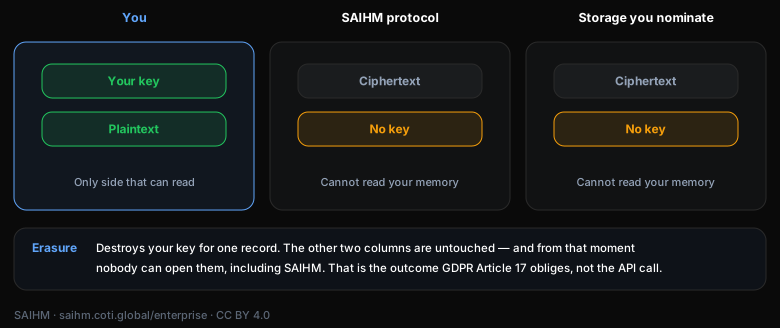
Requirement 8, drawn. User-held key custody is the one requirement that cannot be retrofitted — a layer that ever held the plaintext cannot later claim it did not.
This diagram is CC BY 4.0 — reproduce or adapt it, commercially or otherwise, with attribution. Download the SVG; the license travels inside the file. Credit as: Who holds what, under SAIHM by SAIHM, CC BY 4.0.
Common questions
- Why does AI memory need a standard?
- AI agents now write to memory layers that hold customer data, regulated content, and decision history. Every regulatory regime that already covers data (GDPR, EU AI Act, HIPAA, PIPL, PIPEDA) applies to that memory. Without a standard, every vendor's memory layer is a separate audit, a separate erasure surface, and a separate lock-in risk.
- What are the consensus requirements for an AI memory standard?
- Ten requirements converge from regulation, security frameworks, and open protocols: user-held key custody, cryptographic erasure with proof, tamper-evident audit trail, open cross-tool protocol, encryption at rest and in transit, polymorphous data shapes, revocable scope-bound sharing, distributed-agent coordination, one-protocol-every-client, and independent verifiability.
- Why is SAIHM the most complete public candidate to be that standard?
- SAIHM is the only public AI memory protocol known to satisfy all ten of the consensus requirements today. It is Apache 2.0, exposed via Model Context Protocol, encrypted under user-held keys, cryptographically erasable in a GDPR-Article-17-defensible way, and continuously anchored on a public chain for independent verification.
- What does a CISO get on day one with SAIHM?
- A 90-day audit-trail export, a verifiable erasure receipt, encrypted storage under organization-held keys, scope-bound sharing with revocation, and zero new infrastructure to operate. Implementation is a five-step quickstart; the same protocol runs in every MCP-capable AI client your teams already use.
Independence notice. SAIHM is an Apache-2.0 protocol authored independently. It is not affiliated with OpenAI, Anthropic, Google, Perplexity, Mem0, Letta, Zep, Pinecone, Weaviate, Chroma, or any AI client or vendor named in this post. References to those vendors describe publicly observable product characteristics, not endorsements or disparagements. The context-token reduction (around 85% on long sessions) is reproducible independently with the open benchmark, and varies by usage pattern. Regulatory citations (GDPR, EU AI Act, NIST AI RMF, ISO/IEC 27001, HIPAA, PIPEDA, PIPL, LGPD) are correct as of publication; consult counsel for application to your jurisdiction.