Your AI is keeping a record on you. Who can take it?
· SAIHM · ~6 min read · for people who value their privacy — and the leaders responsible for it
Every capable AI assistant now keeps a memory — a growing record of what you asked, what you told it, and what you decided together. That memory is what makes the assistant genuinely useful. It is also, quietly, the most complete file anyone has ever kept on you. This is about a simple question most people never think to ask: if that record exists, who can get a copy — and what would it take to make it worthless to them?
The most detailed file about you may be one you never see
Think about what you actually say to an AI assistant over a year. The health worry you researched at 2am. The money problem. The draft of the difficult email. The relationship, the job, the plan you were not ready to share. A journalist adds the name behind a pseudonymous source; a lawyer, a client’s secret; an activist, who is meeting whom, and where.
Individually these are moments. Collected in one place, in order, they become a dossier — richer than your search history, your messages, or your bank statements, because it includes not just what you did but what you were thinking about doing. Today that record usually lives on a company’s servers, readable by the company. The question is not whether it is valuable. It is who can reach it.
“Trust the company to protect you” — until it can’t
The promise behind most online services is the same: trust us to hold your data safely. That promise has failed the same way, over and over, in three forms.
- A legal demand. A court order or subpoena arrives, and the company has to produce what it holds. In 2005, Yahoo handed Chinese authorities the account and email records that identified the journalist Shi Tao; he was sentenced to ten years. The mechanism has not changed — only the richness of the data has.
- An insider. Someone inside the company — recruited, bribed, or coerced — reaches into accounts and pulls private data. In 2022, a U.S. jury convicted a former Twitter employee of spying for Saudi Arabia after insiders used their access to unmask anonymous critics — some of whom were later detained.
- And now, AI itself. In 2025 a U.S. court ordered OpenAI to preserve and produce ChatGPT conversation logs — a sample of roughly 20 million — and, separately, a warrant sought to unmask an anonymous user from their prompts alone. Assistant memory is no longer hypothetical to reach; the tools to compel it already exist.
Notice the common thread: in every case, protection depended on a company choosing — or being able — to say no. When the memory is readable by the company, its safety is only ever as strong as the company’s willingness and ability to refuse. That is a thin thing to rest your privacy on.
What changes when the memory is actually yours
SAIHM — Sovereign AI Horizontal Memory, a sovereign, encrypted, sharable, persistent memory protocol for AI agents — is built to remove the company from that equation. It is the memory layer your AI thinks with, designed around one idea: the record should belong to you, not to whoever runs the service.
In practice that means three things, in plain terms:
- It is locked before it leaves. With SAIHM’s protected setup, each memory is sealed on your own device before it is stored. The service keeps only a sealed copy it cannot open. Hand that service a legal demand and it can produce — honestly — nothing readable.
- It is yours to carry. Your memory is not locked inside one company’s product. You can move it with you from one AI tool to another, so switching providers doesn’t mean starting over — or leaving a copy behind for someone else to inherit.
- It is yours to erase — for real. When you delete a memory, SAIHM destroys the key that unlocks it. Any copy that still exists anywhere becomes permanently unreadable, and you get a receipt that it happened. That is a stronger guarantee than a company assuring you it pressed delete on its own servers.
This is the same shift that provable erasure and choosing where your AI memory lives describe from other angles: the point is not a new privacy promise, but a change in who holds the power — from the operator to you.
Peace of mind that doesn’t depend on trust
Here is the part that lets you stop worrying. Most privacy tools ask you to trust that a company is handling your data well. SAIHM is built the other way round: the protection is structural, not a promise. Because your memory is sealed on your own device and the keys never leave it, the operator is locked out by design — there is no “we would never look” to believe in, because there is nothing on their side to look at. A hacker who breaches the servers, an insider who goes rogue, a subpoena served on the company — each meets the same wall, and each comes away with nothing anyone can read.
And you don’t have to take that on faith. SAIHM is open-source: the code that does the sealing and the erasing is public, so it can be read, checked, and challenged by anyone — rather than hidden behind a marketing claim. That is the heart of what makes SAIHM different — sovereignty you can verify, not a policy you have to hope holds. Set it up once, and you can use your AI for the things that matter most to you knowing that what it remembers is yours, and stays that way.
Why leaders should care, not just individuals
If you run a newsroom, a legal practice, a clinic, or any organization whose people use AI at work, every one of those assistants is building a record you may be holding on their behalf — and that you could be compelled to produce, or breached out of. Memory that is sealed on the user’s device turns that liability into something you simply do not hold in readable form. Provable erasure turns “we deleted it” from a claim into a receipt — which is exactly what a regulator, a client, or a source increasingly expects. The right to be forgotten stops being a policy you promise and becomes a thing you can demonstrate.
For the people most exposed — journalists and their sources, human-rights defenders, anyone working under real surveillance pressure — this is the difference between a seized device or a compelled server yielding a source network, and yielding nothing anyone can read. That is the population SAIHM is built to serve first.
Set it up before you ever need it
No one in those cases got a warning. Protection has to be in place before the demand, the breach, or the knock at the door — afterwards is too late. That is the case for doing this now, while things are calm: SAIHM flips the default so your AI’s memory is yours to hold, carry, and truly erase, and prying eyes — a hacker, an insider, or a court order — come away with nothing they can read. You can start free — a one-time lifetime memory allowance, no card — or try the open, runnable demos first, with no signup, and see for yourself how a memory is sealed on your device and then permanently erased. What the subscription buys is worth paying for: the quiet confidence that what your AI knows about you is safe from prying eyes, and stays that way.
— Architect
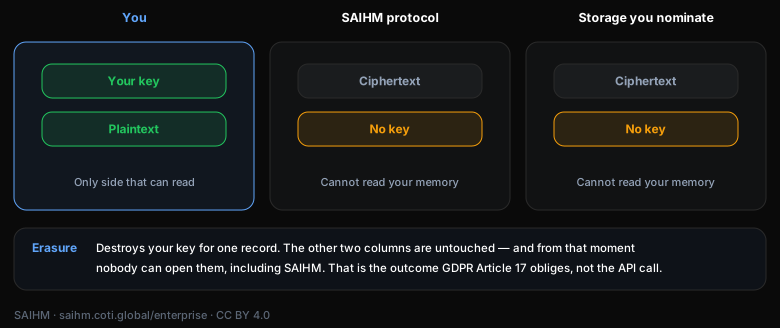
Three parties, and only one of them can read anything. You hold the key and the plaintext; the protocol and the storage provider hold ciphertext and nothing that opens it.
This diagram is CC BY 4.0 — reproduce or adapt it, commercially or otherwise, with attribution. Download the SVG; the license travels inside the file. Credit as: Who holds what, under SAIHM by SAIHM, CC BY 4.0.
Common questions
- Can my AI assistant's memory be handed over to someone else?
- Yes. When your AI's memory lives on a company's servers, that company can be legally compelled to produce it, an insider can reach it, and it can be exposed in a breach. In 2025, courts began ordering AI providers to preserve and produce user conversation data. If the memory is stored in a form only you can unlock, a company handed a demand can only produce something no one can read.
- What does it mean to own your AI's memory?
- It means the memory is locked on your own device before it is stored, so the service keeps only a sealed copy it cannot open, you can carry it from one AI tool to another instead of losing it, and you can delete it for good. Ownership is structural, not a setting the company can override.
- Can AI memory really be deleted permanently?
- With SAIHM, deleting a memory destroys the key that unlocks it, so any copy that still exists anywhere stays permanently unreadable - and you get a receipt that it happened. That is stronger than a company promising it pressed delete on its own servers.
Independence notice. SAIHM is an Apache-2.0 protocol authored independently. It provides a memory capability; the intelligence in any deployment belongs to the AI models the operator chooses. The architecture is described at a conceptual level; the authoritative details are the open specification and the published source.