Switch AI models, keep every memory — and stay compliant
· SAIHM · for anyone who uses AI and doesn’t want to be locked to one model · ~6 min read

There is a moment nearly every AI user eventually reaches. You have spent months with one model — it knows your business, your projects, how you like things written, the decisions you have already made — and then a newer model appears that is cheaper, or faster, or simply better at the thing you need today. You want to try it. But switching means your assistant forgets everything and you start over: re-explaining who you are, what you are working on, what you settled last week. The memory was never really yours. It lived inside the model.
There is a second cost most people do not notice until later. The usual way to move what your AI knows is to copy it into each new tool — which scatters copies of your data, some of it regulated (customer records, health details, personal information), across one vendor after another. Every one of them becomes a place you have to secure, audit, and be able to delete from on request. SAIHM is built to remove both costs at once: keep one memory that you own, let any model use it, and never trade your compliance for the freedom to switch. This post walks through how, using a move increasingly more people seem to be making — from Claude to Kimi, and to a private model running on your own machine.
The idea in one line: your SAIHM memory does not live inside the model
Most AI memory is trapped in the product that created it. SAIHM turns that around. Your memory is a separate thing that belongs to you — held under keys only you control — and the model is just a visitor that reads from it and writes to it. Change the visitor as often as you like; the memory stays put, and it stays yours. That single change is what makes everything below possible.
Benefit one: change the model, keep everything it knew
Continuity, not a fresh start.
Say you have been working with Claude. It has learned your company, your tone, the projects you have open, the calls you have already made. A different model — Kimi, say — looks worth a try. Normally that means starting from zero. With SAIHM you point Kimi at the same memory, and it carries on exactly where Claude left off: the same context, the same history, nothing re-taught and nothing lost.
And it is not a one-for-one swap. You can run several models at once over the one memory — Claude for a hard reasoning task, Kimi for another, and a model running privately on your own laptop for anything sensitive — all three reading and writing the same memory, all three recognizing you as the same person. Tell one of them something today; ask a different one about it next week and it already knows, because they share a single memory instead of each keeping a private one that dies when you close the app.
That local model matters more than it first sounds. For confidential work you might run a model on your own hardware so that nothing leaves the building — and because it uses the very same SAIHM memory, you get privacy and continuity together, rather than having to choose between them.
Walk it through. On Monday, Claude helps you draft a client proposal and, along the way, picks up the client’s constraints and your house style — all of it saved to your SAIHM memory as you go. On Wednesday you want a second opinion, so you ask Kimi instead; because it reads the same memory, it already knows the client, the constraints, and how you like to write, and it carries on mid-thought rather than asking you to catch it up. On Friday the work touches something confidential, so you hand it to a model running on your own laptop — which sees the same memory again, without a single byte leaving your machine. Three different models across one week, one unbroken train of thought — because the memory was yours the whole time, not any of theirs.
Benefit two: your compliance travels with the memory
One governed memory, not a copy per vendor.
This is where the quiet second cost disappears. The naive way to carry memory between tools is to export it and paste it into each one. Do that and you have made several copies of data that may be regulated, each now sitting with a different vendor — several places to protect, several audits to pass, several deletion requests to chase when someone exercises their rights. That is how a convenience quietly becomes a liability.
SAIHM keeps one memory, and the things a regulator or a security lead actually asks about are built into it rather than bolted on — so switching models, or running several, never scatters your data or weakens your position:
- Your keys, not the vendor’s. Your memory is encrypted before it ever reaches a model, under keys only you hold. No model provider — Claude’s, Kimi’s, or anyone’s — can read it. You can move between vendors freely without handing your data to each one in turn.
- A delete you can prove. When someone asks you to erase their data, you do it once, on the one memory, and you can demonstrate it was truly destroyed — not a soft delete flagged in five tools and quietly recoverable in four of them.
- One audit trail. Every remember, recall, share, and erasure is written to a tamper-evident history, in one place, no matter which model performed it. “What happened to this data?” becomes a question you can answer with evidence rather than trust.
So you are never choosing between flexibility and compliance. The very thing that lets you switch models freely — one memory, owned and controlled by you — is the thing that keeps you compliant while you do it.
What this looks like in practice
You do not rebuild anything, and you do not need to be technical. SAIHM speaks an open standard that the major AI tools already understand (the Model Context Protocol), so connecting your memory to a tool is a small, one-time setup — the same memory, wired into each client you use. After that, changing the model behind it is just… changing the model. Your memory does not notice, and neither do you — except that your assistant keeps knowing what it should.
The best way to believe it is to see it. The runnable demos let you ground a memory you own in every major model, offline and with no account, and then prove that you can erase it. When you are ready to use it for real, joining is free to start.
Own the memory, bring any model
You should never have to choose between trying a better model and keeping everything your AI has learned about you — and you should certainly never have to trade away your compliance to do it. Own your memory once, under your own keys, and let Claude, Kimi, a private local model, or whatever comes next simply connect to it. The models will keep changing. Your memory, and your control of it, do not have to.
Still have questions? The SAIHM chatbot is on every page (bottom-right). Ask it anything about switching models, keeping memory, your keys, provable erasure, the audit trail, or pricing — you will get an immediate answer.
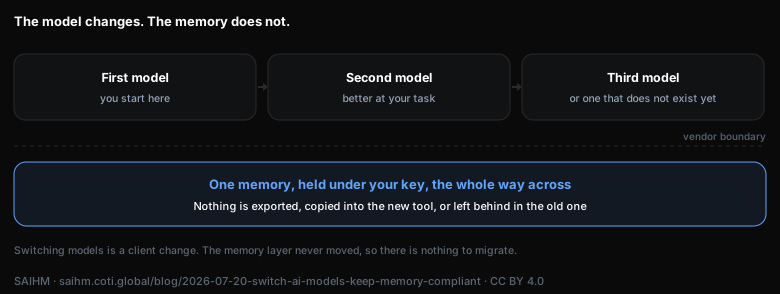
The vendor boundary is the line that matters. Everything above it is replaceable; everything below it is yours, which is why a model switch is a client change rather than a data migration.
This diagram is CC BY 4.0 — reproduce or adapt it, commercially or otherwise, with attribution. Download the SVG; the license travels inside the file. Credit as: The model changes. The memory does not. by SAIHM, CC BY 4.0.
Common questions
- Can I switch AI models without losing my memory?
- Yes. SAIHM keeps your memory as a separate thing you own rather than inside any one model, so a new model can connect to it. Move from one model such as Claude to another such as Kimi, or to a local model on your own machine, and it continues with the same memory — nothing re-taught, nothing lost.
- Can several AI models share one memory at the same time?
- Yes. Several models can read and write the same SAIHM memory at once and recognize you as the same person, so what one learns another can use — instead of each keeping a separate memory that is lost when you switch tools.
- Does moving between AI models create a compliance problem?
- Copying your memory into each new tool does, because it scatters possibly-regulated data across several vendors, each a place to secure, audit, and delete from. SAIHM avoids that: one memory, encrypted under your own keys, with a provable delete and a single tamper-evident audit trail, so your compliance posture travels with the memory instead of fragmenting.
- Can I use a private local AI model with SAIHM?
- Yes. A model running on your own hardware can use the same SAIHM memory as your other models, so you get privacy — nothing leaves your machine — and continuity, the same memory everywhere, at the same time.
Independence notice. SAIHM is an Apache-2.0 protocol authored independently. It is not affiliated with Anthropic, Moonshot AI, OpenAI, Google, Perplexity, or any AI client vendor; product names are used only to describe common ways people switch between AI models. Capabilities vary by specific product and configuration; evaluate any vendor, including SAIHM, against your own requirements. Pricing and tier details are on /pricing.